Hole Diameter Calculator
Use this Hole Diameter Calculator to find the correct PCB hole size. Enter the Lead Diameter(C) and Clearance(I) to calculate the required Hole Diameter.
Enter Lead Diameter(C) and Clearance(I) value to calculate the Hole Diameter.
What is Hole Diameter?
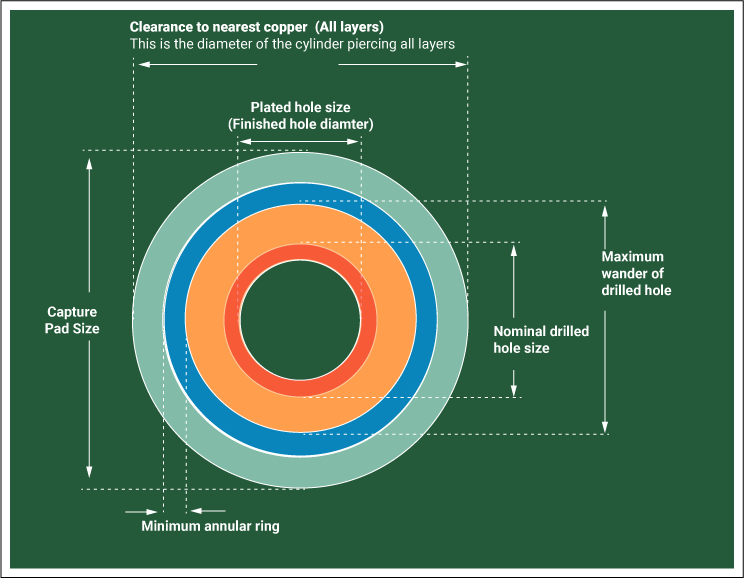
Hole diameter in a PCB refers to the diameter of the drilled hole used to insert the leads of through-hole electronic components.
Components such as resistors, capacitors, connectors, and diodes have metal leads that must pass through holes drilled in the PCB. The hole must be slightly larger than the component lead to allow easy insertion and proper soldering.
If the hole is too small, the component lead may not fit properly. If the hole is too large, the component may not sit securely, leading to weak solder joints.
Therefore, selecting the correct hole diameter ensures proper mechanical fit and reliable electrical connection.
Uses of Hole Diameter Calculation
Hole diameter calculation is important for proper PCB assembly and manufacturing.
Common uses include:
- Designing through-hole component footprints
- Ensuring proper component lead insertion
- Preventing tight or loose component fitting
- Improving soldering quality
- Meeting PCB fabrication design rules
Correct hole sizing ensures smooth PCB assembly and long-term reliability.
Hole Diameter Calculation
The hole diameter is determined by adding a clearance value to the component lead diameter.
Clearance provides extra space around the lead to allow:
- Manufacturing tolerances
- Easy component insertion
- Proper solder flow during soldering
By adding the clearance to the lead diameter, the required drilled hole size is obtained.
Hole Diameter Equation:
Hole Diameter (mm)=Lead Diameter (C) (mm)+Clearance (I) (mm)
where
- Lead Diameter (C): Actual diameter of the component lead.
- Clearance (I): Extra space added for tolerance and ease of assembly.
Applications of Hole Diameter in PCB Design
Through-Hole Component Placement
PCB Manufacturing
Reliable Solder Joints
Mechanical Stability
PCB Design Standards

